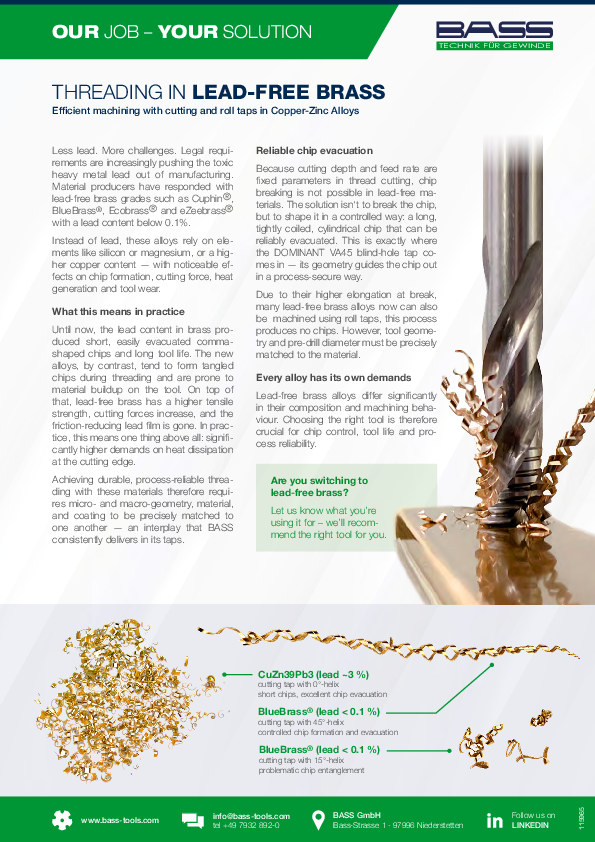
Less lead. More challenges. Legal requirements are increasingly pushing the toxic heavy metal lead out of manufacturing. Material producers have responded with lead-free brass grades such as Cuphin®, BlueBrass®, Ecobrass® and eZeebrass® with a lead content below 0.1%.
Instead of lead, these alloys rely on elements like silicon or magnesium, or a higher copper content — with noticeable effects on chip formation, cutting force, heat generation and tool wear.
What this means in practice
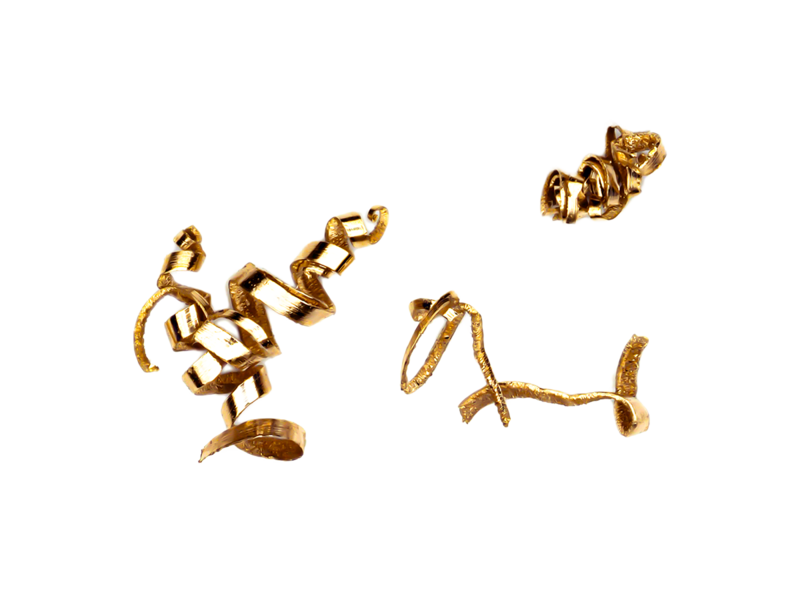
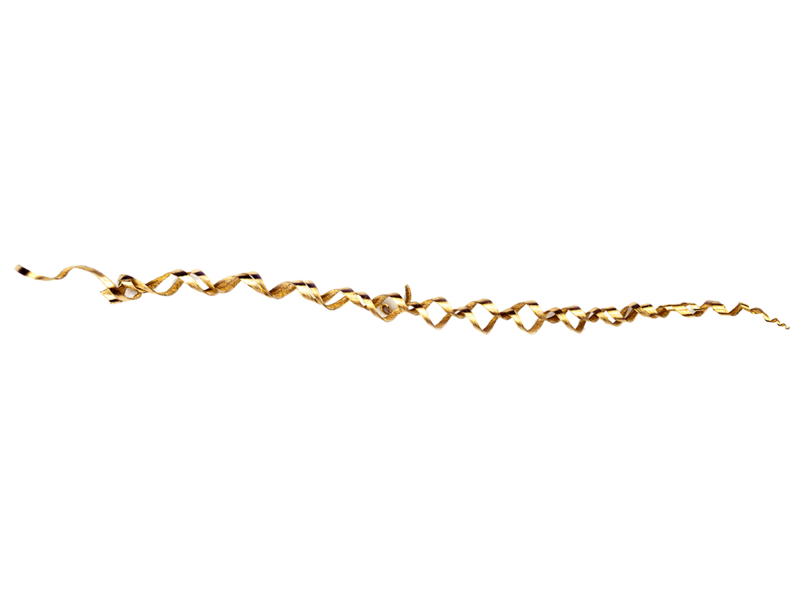
Until now, the lead content in brass produced short, easily evacuated comma-shaped chips and long tool life. The new alloys, by contrast, tend to form tangled chips during threading and are prone to material buildup on the tool. On top of that, lead-free brass has a higher tensile strength, cutting forces increase, and the friction-reducing lead film is gone. In practice, this means one thing above all: significantly higher demands on heat dissipation at the cutting edge.
Achieving durable, process-reliable threading with these materials therefore requires micro- and macro-geometry, material, and coating to be precisely matched to one another — an interplay that BASS consistently delivers in its taps.
Reliable chip evacuation
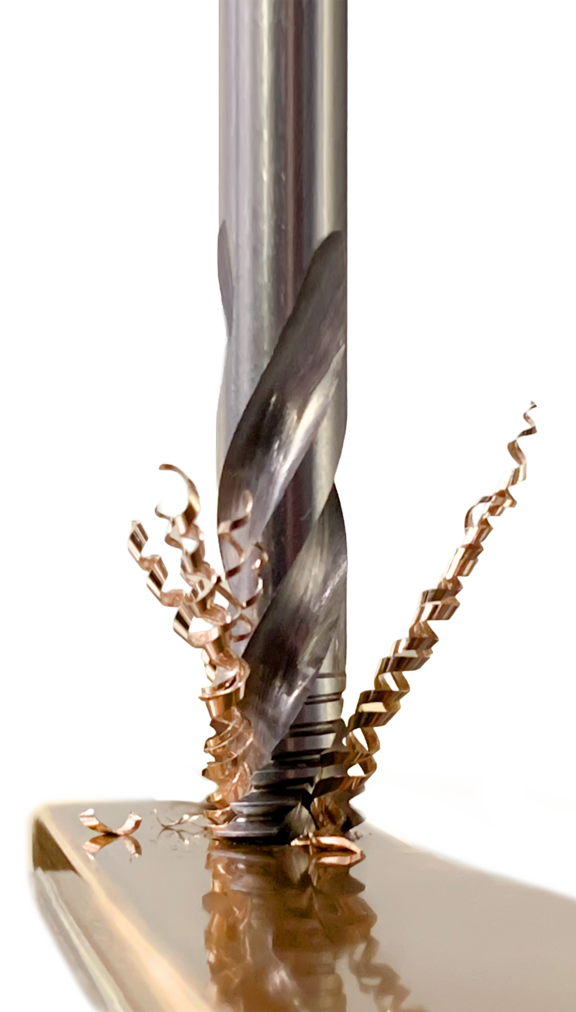
Because cutting depth and feed rate are fixed parameters in thread cutting, chip breaking is not possible in lead-free materials. The solution isn‘t to break the chip, but to shape it in a controlled way: a long, tightly coiled, cylindrical chip that can be reliably evacuated. This is exactly where the DOMINANT VA45 blind-hole tap comes in — its geometry guides the chip out in a process-secure way.
Due to their higher elongation at break, many lead-free brass alloys now can also be machined using roll taps, this process produces no chips. However, tool geometry and pre-drill diameter must be precisely matched to the material.
Every alloy has its own demands
Lead-free brass alloys differ significantly in their composition and machining behaviour. Choosing the right tool is therefore crucial for chip control, tool life and process reliability.